


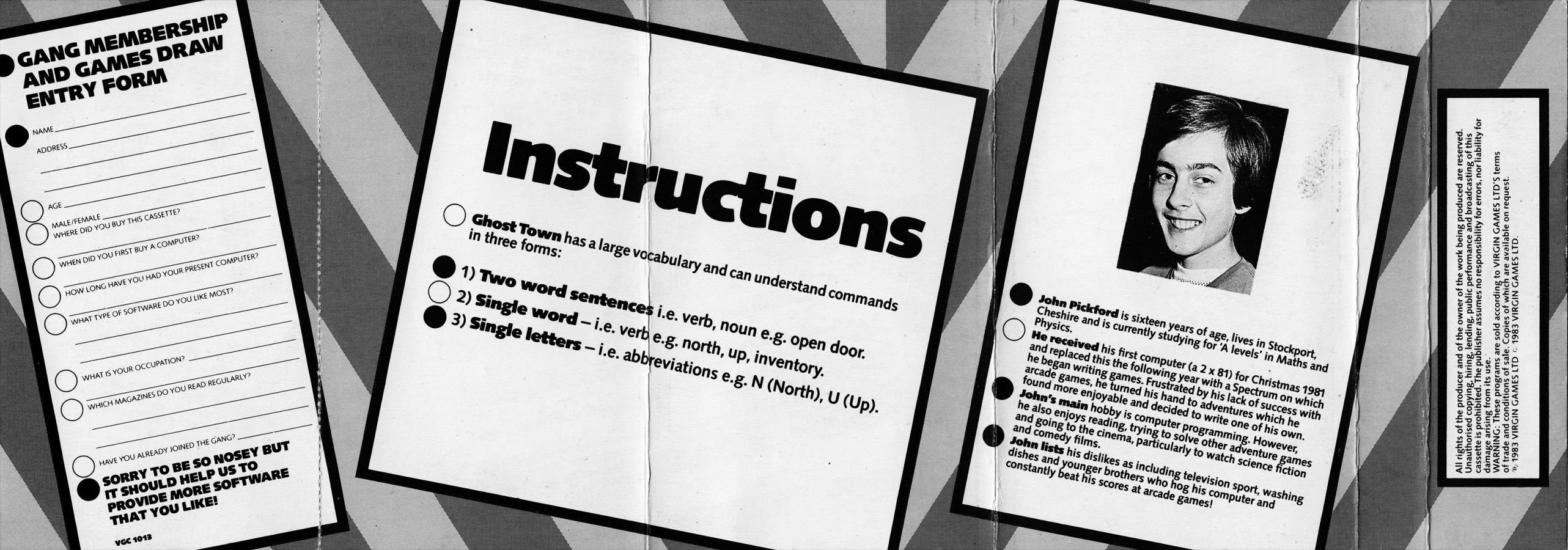
In 1983, Virgin Games paid £500 for a ZX Spectrum game called Ghost Town, a text adventure with some limited graphics and a gold rush setting. It was one of its programmer’s earliest published games, and Virgin released it with a profile of him (and accompanying photo) on the cassette inlay. “John Pickford is sixteen years of age, lives in Stockport, Cheshire, and is currently studying for ‘A levels’ in Maths and Physics.” Under a section on his dislikes, it mentions “younger brothers who hog his computer and constantly beat his scores at arcade games!”.


John’s younger brother Ste Pickford was a keen artist as well as a fan of arcade games. As John progressed further into making games, he helped Ste to get a job on a high profile arcade conversion. Nigel Alderton of Elite Systems paid Ste, then fifteen years old, £50 to work as a graphic artist on the Amstrad version of Ghosts’n Goblins. Alderton gave Ste “a pile of photographs” to work from before later taking him to Elite’s office for an all-nighter playing the arcade game. Pickford’s loading screen design got used for the Commodore 64 as well.
Around this time, John joined the developer Binary Design. He used one of Ste’s font designs in Death Wake, and then Ste did work experience at Binary Design and worked on loading screens for a Max Headroom game. His stint there was elongated, and then he kept on doing more work, contributing to the game that was the brothers’ first joint commercial success. Both worked on Glider Rider, an isometric hang-glider game which reached #10 in the combined formats chart in September 1986.


Shortly after that, Binary Designs offered Ste a proper job and actually started paying him. He worked on graphics and animation for darts game 180, a #2 hit published by Mastertronic sub-label M.A.D. (Mastertronic Added Dimension). Then Binary Designs shifted teams around and put the Pickford brothers on the same team, and they pretty much worked together from then on. Together they made a choice of how to approach their games which they later explained to Retro Gamer: “We quickly realised there were two ways of doing it. Meeting stupid eight-week deadlines, which made it impossible to make a decent game, or do a good game and fuck the deadline.” They took the latter approach. They soon had another minor hit for Mastertronic with Hyperbowl reaching #18 early in 1987, and it would be Mastertronic that would publish the game that would be the brothers’ #1 hit.


180’s release on M.A.D. was part of a move for Mastertronic to branch out, having expanded to one of the UK’s most successful publishers with a focus on distribution and a low £1.99 price tag. They wanted to try slightly higher prices, but only on a separate label. The £2.99 180 was as big a success as Mastertronic ever got on M.A.D., but the idea of running multiple labels stuck. They launched Entertainment USA, along very much the same initial principles as U.S. Gold. Then, leaning not quite as far into equivalent British branding, they decided to release some games under the name Bulldog, which they’d ended up acquiring from a collapsing customer. Binary Design, and the Pickford brothers, came up with the launch title for Bulldog, Feud.


The initial concept for Feud was John’s, and involves two wizards: Learic (the player) and Leanoric (their opponent). Each has the power to craft spells using the right herbal ingredients, and they are out to use that power against each other. All with little regard to the ordinary people around them, as the game’s instructions set out in some detail conversational yokel speak — “They’s about to start a feudin’ an’ woe betide the poor soul who gets in their way”. The motivation of the wizards is that they are feuding brothers. Perhaps they fell out because Leanoric hogged Learic’s cauldron and constantly beat his arcane high scores.
In practice, the game is a flip-screen action adventure in which you spend the majority of your time searching for and collecting herbs, with particular pairs needed to craft individual spells. John and Ste spent a lot of time in advance planning out the map, a new approach compared to previous games where they had made it up as they went along. Their effort shows, with the game including interesting winding mazes, lots of distinct areas and landmarks, and more of a feeling of this being a real place than was the norm. And as Crash and Zzap! 64’s short-lived Amstrad cousin Amtix! wrote in a review in their final issue, “the graphics in Feud are a delight to behold with very well animated characters and pretty, colourful scenery”.


Nice as it might be to wander around in Feud, though, at some level the ingredient-gathering feels rather like playing Sabre Wulf but with all of the action removed. That’s probably what Your Commodore had in mind when they wrote that “The screen looks like an early Ultimate game which gives the game a dated feel”. ZX Computing complained that “you spend most of the time wandering around bits of forest and along dead-end pathways looking for flashing flowers”. That’s where the Pickford brothers’ really transformative idea for Feud comes in, which is that your meandering through the woods might be interrupted at any time by Leanoric arriving to set you on fire or smite you with lightning.
There is a compass on screen at all times, which tells you where your rival is relative to you, but not how far away. Aside from devising the map, the other thing that most crucial work went into for Feud was developing the AI that means that Leanoric is a rival operating in exactly the same way as you, subject to the same constraints. When he arrives you each have just moments to take your shot or to get away, depending on your relative strength. As Rachael Smith wrote in Your Sinclair, “The game may appear slow […] but the race for herbs soon becomes tense, particularly when you find yourself and your arch-rival in the same screen, chasing for a bloom.”


The first time I played Feud a few years ago, its approach with your rival immediately stood out to me as both brilliant and well before its time. As I wrote then, “it’s a mechanic which would work even better if, say, you played the game against another human using two different screens where you couldn’t see each other, perhaps connected by a series of tubes. But the appeal of it shines through even without all that in place yet.” The Pickford brothers, it turns out, have often made the same observation in different words. The page for Feud on their old website begins with the declaration “the original Deathmatch!”
Their site labels it “a proper Pickford Bros game” and it was their design, supported by programming by others at Binary Design. Pete Harrison, who had worked with them on Max Headroom and Glider Rider, handled the ZX Spectrum version, for which Ste Pickford designed a simpler title screen better suited to the Spectrum’s capabilities. Ste also saw the opportunity to design really big animated sprites as an unusual treat, later calling Feud the Spectrum game he was most happy with. The Amstrad version was by Jas C. Brooke, who worked on another game I will encounter before the end of 1987. The Spectrum and Amstrad versions both got excellent reviews, and the Spectrum one won a Crash Readers’ Award, albeit the one for Easiest Game.
The Commodore 64 version, meanwhile, was the responsibility of John Flynn, something which Ste Pickford did not end up very pleased with. As he wrote on the brothers’ website: “The programmer was one of those guys used to working on his own, doing his own graphics and sound for his own game, and not only was he not that well adapted to working in a team, he also didn’t take well to the (then new) idea of there being a ‘game designer’ involved telling him how the game would work.” On the C64, the map, AI and controls are all noticeably lacking compared to the other versions, with unique issues like getting stuck when trying to walk across a bridge over the river in anything other than the perfect vertical position.


The Commodore 64 reviews reflected this difference. “Sadly the 64 version falls well short” wrote Chris Cain in Commodore User, before ending by suggesting “go and see it on the Amstrad to see exactly what you’re missing”. Zzap! 64 were only a little more positive, with Julian Rignall saying that “I didn’t like it much because there’s nothing new to make it different and exciting. Having said that, it’s only three quid, and could prove a worthwhile purchase to an avid arcade adventurer.” The detailed records of Mastertronic Collectors Archive show that the Commodore 64 version was the worst-selling of the three, which was fairly unusual.
Feud spent at least four weeks at the top of the UK charts (available chart info gets a little patchy for a couple of years here) and no other Bulldog game ever did as well again. The Pickford Brothers went on to a long career in game development, including working for Rare (who took one of their designs and turned it into Jetpac sequel Solar Jetman). Their mobile game Magnetic Billiards: Blueprint was nominated for a Bafta award in 2012. And Feud has maintained a following. In the course of my research I found a rather lovely nostalgic post from someone declaring it their favourite game ever. Not a bad outcome for a pair of bickering brothers.


Sources:
- Feud, The Pickford Bros, Zee-3, 2010, accessed via the Wayback Machine
- Assorted other pages from The Pickford Bros’ Softography, The Pickford Bros, Zee-3, 2010, accessed via the Wayback Machine
- Pickford brothers, Retro Gamer No. 19, December 2005
- The classic game: Feud, Retro Gamer No. 35, March 2007
- A moment with… Ste Pickford, David Crookes, Retro Gamer No. 77, June 2010
- Sinclair ZX Spectrum: a visual compendium, Bitmap Books, 2015
- Mastertronic Style – Part 3, New labels – MAD, Bulldog, Entertainment USA, Anthony Guter, Mastertronic Collectors Archive, 2024
- Mastertronic: The Big Hitters (They Sold Millions, Part 3), Warren Pilkington, Mastertronic Collectors Archive, 2026
- Reviews – Feud, Amtix! No. 18, April 1987, accessed via the Internet Archive
- Future Publishing, Sham Mountebank, Where Were They Now?, 2025
- Reviews – Feud, T.H., Your Commodore No. 32, May 1987, accessed via the Internet Archive
- Spectrum game reviews – Feud, ZX Computing No. 36, April 1987, accessed via Spectrum Computing
- Screen Shots – Feud, Rachael Smith, Your Sinclair No. 16, April 1987, accessed via Spectrum Computing
- Screen Scene – Feud, Chris Cain, Commodore User No. 44, May 1987, accessed via Amiga Magazine Rack
- Zzap! test – Feud, Zzap! 64 No. 26, June 1987, accessed via Def Guide to… Zzap! 64
- My Life With… Feud – ZX Spectrum, Retro Arcadia, 2022
1 Comment
1 Pingback